The Conversation, January 14, 2019
The federal government has asked Bill Blair, the minister of border security and organized crime reduction, to consider whether Canada should ban handguns and “assault-style” rifles.
The media has focused mostly on
the possibility of banning handguns. The idea of outlawing assault-style
weapons, however, deserves more attention because this proposal could help
avoid mass shootings but is extremely controversial among firearm owners.
The federal government’s engagement paper on possible new gun legislation notes that Canada’s current firearms legislation contains no definition of an assault rifle.
The paper instead offers an
illustrative description from the United States Department of Justice: “In
general, assault weapons are semi-automatic firearms with a large magazine of
ammunition that were designed and configured for rapid fire.”
This definition suggests that
the federal government is considering a ban on many semi-automatic rifles —
that is, guns that can be fired each time the trigger is pulled. Such guns are
distinguishable from manual action firearms that require shooters to use a
mechanism to reload guns after each discharge, thus limiting rate of fire, and
from fully automatic firearms that continue to fire so long as the trigger is
depressed.
Canada has long prohibited the
possession of automatic guns.
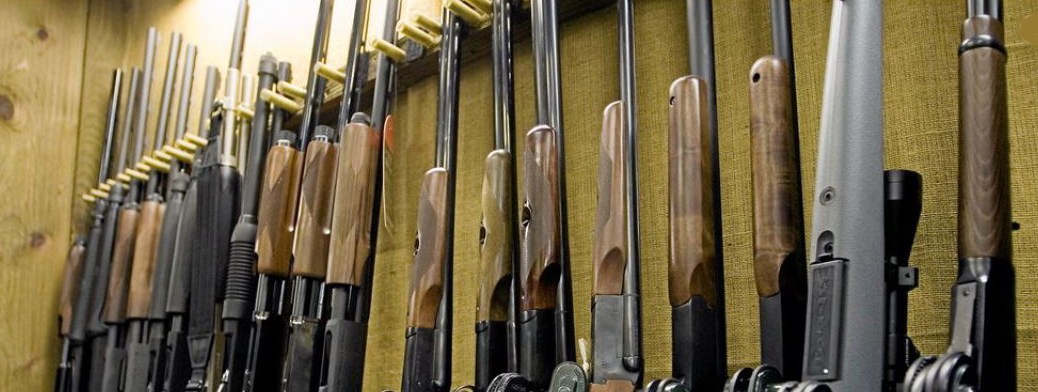
Some semi-automatic firearms are non-restricted, meaning they can be used for hunting and only require purchasers to obtain a basic possession and acquisition licence.
Other semi-automatic guns are
classified as “restricted” weapons. Such guns must be registered and are
usually only fired at shooting ranges. Owners must possess a different licence
and must have authorization to transport such firearms from one location to
another.
Historical context of Canadian
gun control
The interest in stricter
regulations for semi-automatic firearms, particularly guns based on modified
military weapons, reflects historic changes in gun design, marketing and
ownership in Canada.
At the beginning of the 19th
century, long guns were generally single-shot, muzzle-loaded, smooth-bore
weapons that were slow to load, inaccurate beyond approximately 100 metres, and
often misfired.
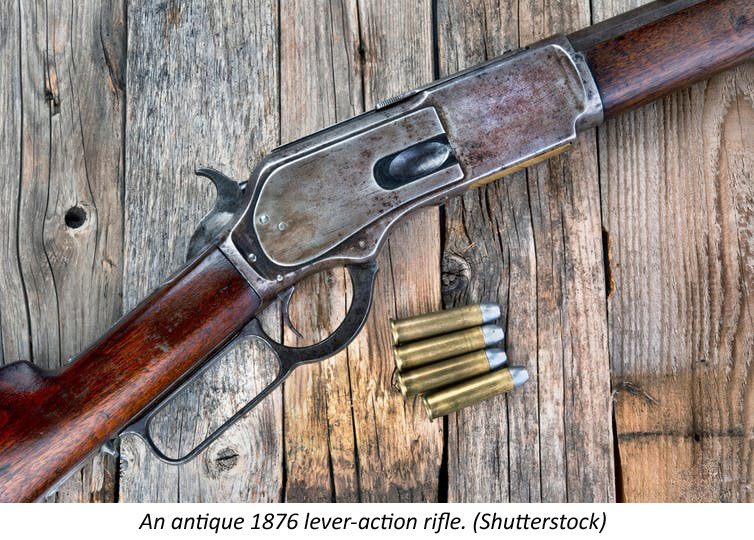
In the mid- to late 19th century, however, breech-loading guns replaced muzzle-loaded weapons. New ammunition and rifled barrels made guns more accurate at long ranges. Manufacturers also developed firearms with magazines that could hold several rounds of ammunition to allow more rapid firing. Typically, these guns used “lever action” or “bolt action” designs to load fresh cartridges into the chamber of the barrel.
When many Canadians think of a
hunting rifle, what comes to mind is one of these guns, such as a lever-action
Winchester rifle. Generations of Canadians used such guns to hunt deer, moose
and other game.
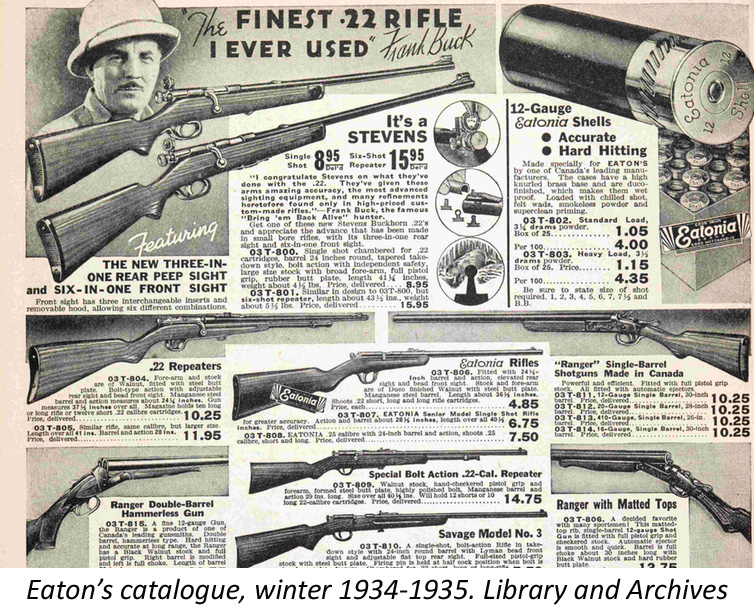
Historic department store catalogues
suggest that the popularity of semi-automatic guns among hunters is quite new.
Stores like Eaton’s, Simpson’s and Army & Navy sold mostly manual-action
firearms.
In 1975, for instance, Eaton’s
advertised few semi-automatic rifles. As semi-automatic firearms entered the
marketplace in larger numbers, however, some Canadians began to express concern
about their availability.
Semi-automatic rifles have been used in many of the most infamous mass murders in Canadian history, including the murder of 14 women in the 1989 Montreal Massacre, the murder of four RCMP officers in Mayerthorpe, Alberta in 2005, the murder of three RCMP officers in Moncton in 2014, and the Quebec mosque shooting of 2017.
Perhaps the first fight over the classification of semi-automatic guns in Canada concerned the AR-15, the firearm used in several recent mass shootings in the United States.
AR-15 restricted in
Canada
In 1977, Ottawa made the AR-15 a restricted weapon. Prime Minister Joe Clark’s government reversed that decision, although Ottawa again declared it a restricted firearm in the 1990s. In 2016, Conservative MP Bob Zimmer sponsored a parliamentary petition asking that the AR-15 be reclassified as a non-restricted firearm. The AR-15, however, remains in the restricted category.
Canadians must decide how
available modern semi-automatic rifles should be.
Many semi-automatic firearms based on military gun designs are now sold in Canada at stores such as Cabela’s. Manufacturers and retailers often call such weapons “modern sporting rifles” to make them sound less threatening.
Several gun groups like the Canadian Coalition for Firearm Rights argue that all semi-automatics with barrels of a certain length should be non-restricted. They suggest that guns like the AR-15 are restricted simply because of their physical resemblance to military weapons, and have urged politicians to make such guns non-restricted.
In 2016, the Conservative Party considered this change at its national convention, and Maxime Bernier has made this proposal part of his People’s Party platform.
Gun control advocates, meanwhile, question why many semi-automatics, including the Ruger Mini-14 used in the Montreal Massacre, are non-restricted.
The federal government may prove
reluctant to prohibit such guns because of opposition from gun groups.
Another option
Another option is possible,
however. Ottawa could make all semi-automatic rifles restricted weapons. This
would force owners to pass a more rigorous screening process, require the
registration of such guns and place limits on how they’re used and transported.
This is not a new idea. In 1977, the Canadian Association of Chiefs of Police claimed that semi-automatic guns were “basically designed as an instrument of war” and that they had “no sporting use either in the cultural or recreational sense.” The association thus urged Ottawa “to restrict all semi-automatic weapons as a category.”
Ottawa refused to do it. But
recent mass shootings in Canada have shown that such guns, if misused, are
dangerous to the public and to law enforcement.
Legislators might well keep in mind the words of A.J. Somerset, author of Arms: The Culture and Credo of the Gun. He warns that as long as semi-automatic, assault-style rifles are widely available in Canada, a massacre like the 2016 nightclub shooting in Orlando, Fla., “is not simply a U.S. nightmare on the news; it’s a shadow falling over us, a possibility we can’t ignore.”